M3
A mission management platform for drone-enabled public safety, emergency response, and defense ISR. M3 sits between the sensor payload and the people who need to act on what it observes.
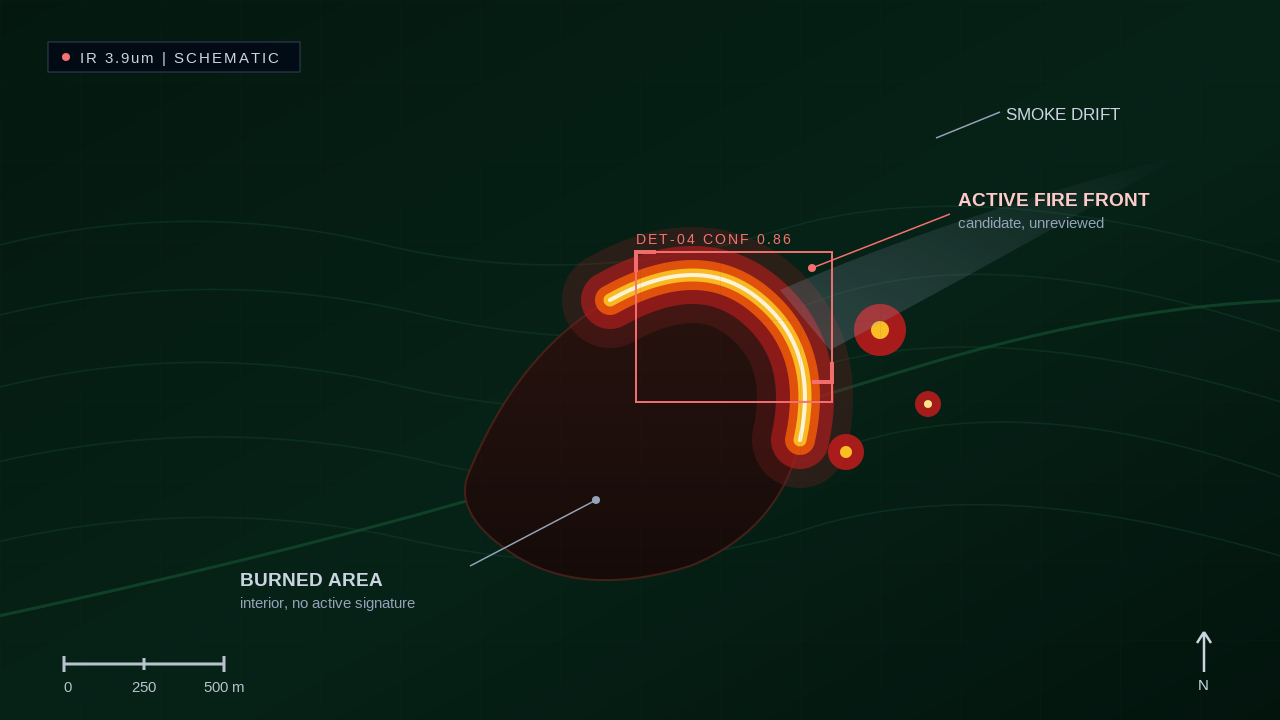
Schematic of the infrared input M3 works from, drawn for illustration. It is not sensor output. Aeryl AI does not collect this imagery: it is captured by the aircraft and payload an operator already flies, and M3 turns it into structured events.
Architecture
Five decisions define what M3 is and what it deliberately refuses to do. Each one has a consequence an agency or a programme office will care about.
The sensor path is separate from the flight control path
Uncrewed aircraft carry two logically distinct data paths: the command-and-control link that flies the aircraft, and the payload path that carries what the sensors observe. M3 integrates only on the second one.
Integration does not require the airframe vendor to open their control interface, and adding M3 cannot affect the link the pilot depends on. It also means M3 is portable across airframes rather than tied to one manufacturer.
Structured detection events, not a video relay
Rather than moving imagery to a viewer and asking a human to watch it, M3 interprets the sensor stream close to where it originates and emits discrete events: what was observed, where, when, and with what confidence.
A detection event is on the order of a kilobit. A usable video stream is several megabits. On the connectivity typically available at an incident, the difference is between a picture that arrives and one that does not.
Ingests existing command-and-control systems
Agencies have already invested in CAD, mapping, and incident management tools, and staff are trained on them. M3 reads from those systems and contributes events back to them.
Adoption does not require an agency to abandon a working system, retrain personnel, or run a competitive replacement procurement.
Browser-based
M3 is delivered as a web application. An operator position needs a browser and a network path — no installed client, no per-machine imaging, no desktop deployment.
A mutual aid partner arriving at an incident can be looking at the same picture in the time it takes to open a laptop, without an IT ticket.
Read-only with respect to the aircraft
M3 has no path to task, steer, retask, or command an aircraft. This is an architectural property, not a configuration setting or a permission that can be granted.
Command authority stays with the pilot at the ground control station at all times. There is no mode in which the software flies the aircraft, and nothing an M3 user can do changes that.
What a detection event contains
Observation
What the sensor registered, classified into a defined event type.
Position and time
Geolocation and timestamp, so events can be ordered and mapped.
Confidence
An explicit numeric confidence value, never presented as certainty.
Review state
Whether a human has confirmed, rejected, or not yet reviewed the event.
Confidence and review state exist for a reason. Automated detection produces candidates, not conclusions. M3 is built so that a person decides what a detection means before anyone acts on it, and so that the record afterwards shows who decided what and when.
Current maturity
M3 is in active development. The platform is not certified, not accredited, and not currently deployed on live emergency incidents. Present work is focused on the event model, ingest from existing command-and-control systems, and evaluation against realistic mission profiles in a simulation environment.
We would rather state that plainly than imply an operational track record we have not yet earned. If you are evaluating M3 for a programme, ask us where a specific capability actually stands and we will tell you.